
We’re Voting YES for a Stronger Einstein!
Election Information:
- When: Wednesday, 5/15 and Thursday, 5/16, between 10m-2pm and 3pm-6pm
- Where: Robbins Auditorium Stage
- Who: Eligible voters are Postdoctoral Fellows on payroll as of April 15.
- How: Bring your Einstein ID, or another form of government-issued identification.
We have a clear choice in this election.
Voting “YES” means Einstein administrators would have a legal obligation to bargain with our elected postdoc representatives over pay, benefits and workplace rights, and to secure any agreements on improvements or maintaining current benefits in a legally binding and enforceable contract. We will be joining nearly 120,000 UAW academic employees across the country in working together to make higher education workplaces more just, fair, and equitable.
Over the course of hundreds of conversations, we’ve seen that postdoctoral researchers at Einstein share many of the same challenges. These include bureaucratic hurdles and insecurity for international workers, unpredictable salary increases that don’t match the high cost of living in New York Ciity, insufficient support for parents, and the lack of enforceable procedures address sexual harassment, discrimination, and bullying. These challenges add unnecessary stress to the postdoc experience and make it more difficult to focus on doing quality research.
Right now, Einstein administrators decide unilaterally if, how, and when to address problems affecting postdocs. With collective bargaining, we will gain the right to meet at the bargaining table as equals. With strong participation and support in our vote we can negotiate a contract that not only improves our pay, benefits, and workplace rights, but also ensures the security and stability that enables us to do quality research.
In hundreds of conversations, and in town halls and other meetings, postdoctoral researchers have already identified some of the common priorities that we could address through a contract. Consider the thoughts of our colleagues and these basic reasons to vote “union yes” on May 15-16th.
Our unionized postdoc colleagues across NYC shared this video message with us ahead of our election.

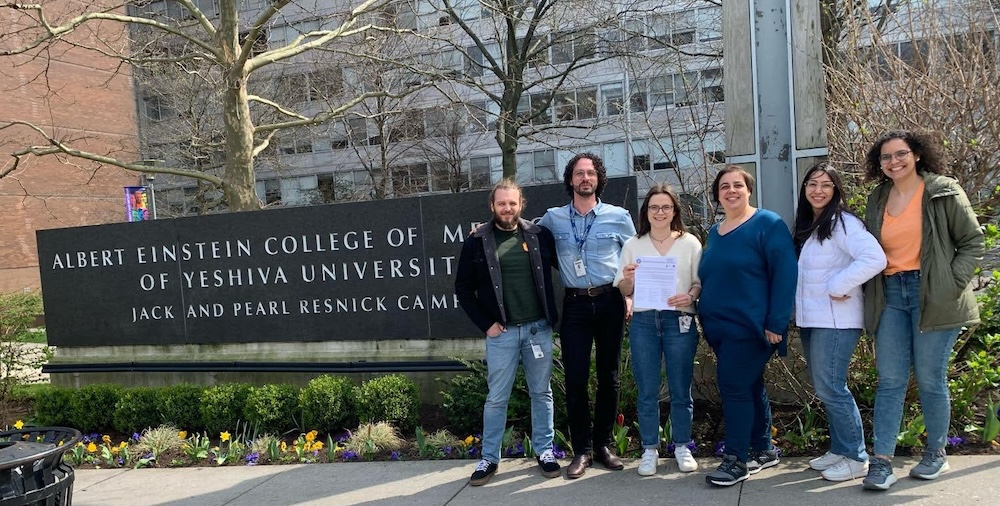
Einstein postdocs delivered an open letter urging Einstein to remain neutral and not to interfere with researchers’ right to make our own decision on unionization
Fair workplace standards enable postdocs to prioritize research.
As postdocs, we drive the research mission of the University, contributing to the discoveries that have established Einstein’s world-class reputation and draws more roughly $200 million in grant funding annually. We do it in the most expensive city in the country, in the face of historically high inflation, with a minimum salary that lags behind other major research institutions in the area.
We are part of a city-wide movement of researchers taking action to improve our lives and research conditions. In 2020, postdocs at Columbia approved their first union contract and took their minimum salaries from the lowest for postdocs in New York City to the highest. In 2023, Mount Sinai postdocs’ contract negotiated minimum salaries that were to the highest in the country and postdocs at Weill Cornell Medicine are currently negotiating for their first union contract.
This city-wide movement has already helped to raise standards even for postdocs without a union – Einstein announced raises last year for years 3 and 4 (followed by further raises this year) shortly after Columbia postdocs negotiated a year 0 minimum of $70,000, and a few months before Mount Sinai postdocs won their year 0 minimum of $72,500 (a 24% increase), with experience-based raises and guaranteed annual raises. It is time for us to come together at Einstein and demand salaries and other benefits that reflect the value of our contributions, and to secure them in a contract, so we can focus on the quality of our research instead of how to make ends meet.
How have other postdocs used a union contract to improve compensation?
University of California postdocs have negotiated the highest pay of any public university postdocs
Princeton postdocs and scholars used collective action to win a 18.5% increase to salaries in 2023
“The first ever postdoc union at a private US university has been formed”
Sinai postdocs won the highest minimum salaries for postdocs in the country
“Many of us arrive at Einstein from abroad with a dream to develop a career in science, work that helps secure hundreds of millions in grants for Einstein annually. Despite our contributions, we must live for years without job security, meaningful career progression, or support to start families. I believe forming a union is a democratic way to win the rights our dedication to science and long hours truly deserves.”
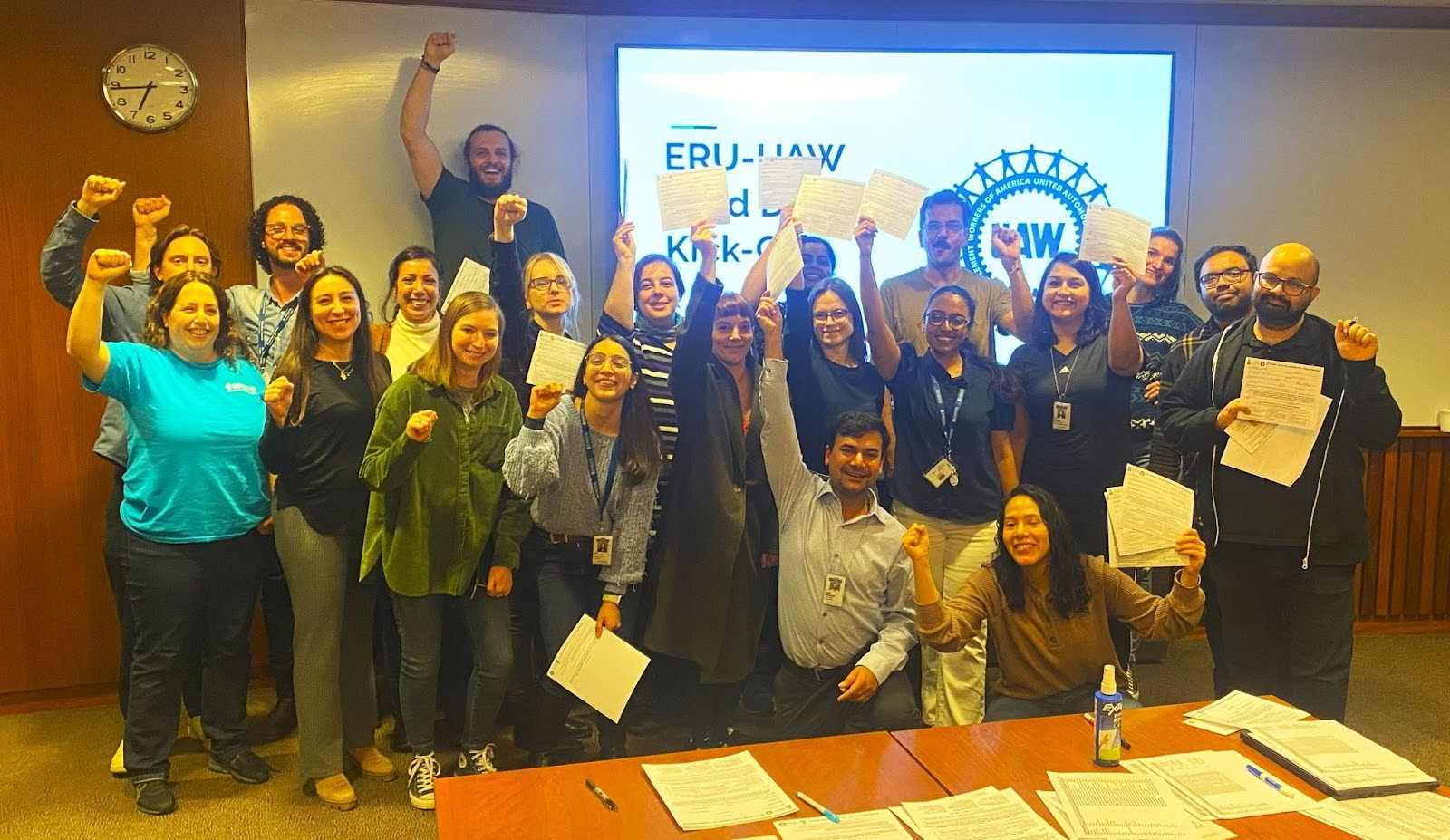
Collective bargaining can create a more accessible postdoc experience.
As postdocs, many of us spend upwards of 50 hours a week in the lab. And because of the high cost of living and housing and a lack of institutional support, many of us, especially those with children, are forced to live increasingly far from work, at a moment in our postdocs when we have the most experience in our labs and provide the most value to the institute. Spending hours commuting each day is bad for our families and takes time away from our research and has placed unnecessary pressure on researchers. Standing together we can demand better support and negotiate changes that improve our quality of life.
How have postdocs at other institutions used a contract to improve the postdoc experience?
Read about the growth of postdoc unions in Inside Higher Ed
Read about all the improvements UC postdocs have negotiated to improve and stabilize their work
“As a postdoc, I’m expected to produce world-class science with minimal wages and benefits while living in one of the most expensive cities in the world. Unionizing would give postdocs more power to improve our salary and benefits through negotiating our working conditions. We would go from having no way to talk as equals with Einstein to having a guaranteed right to engage in dialogue, in which we would all have a voice through a democratic process.”
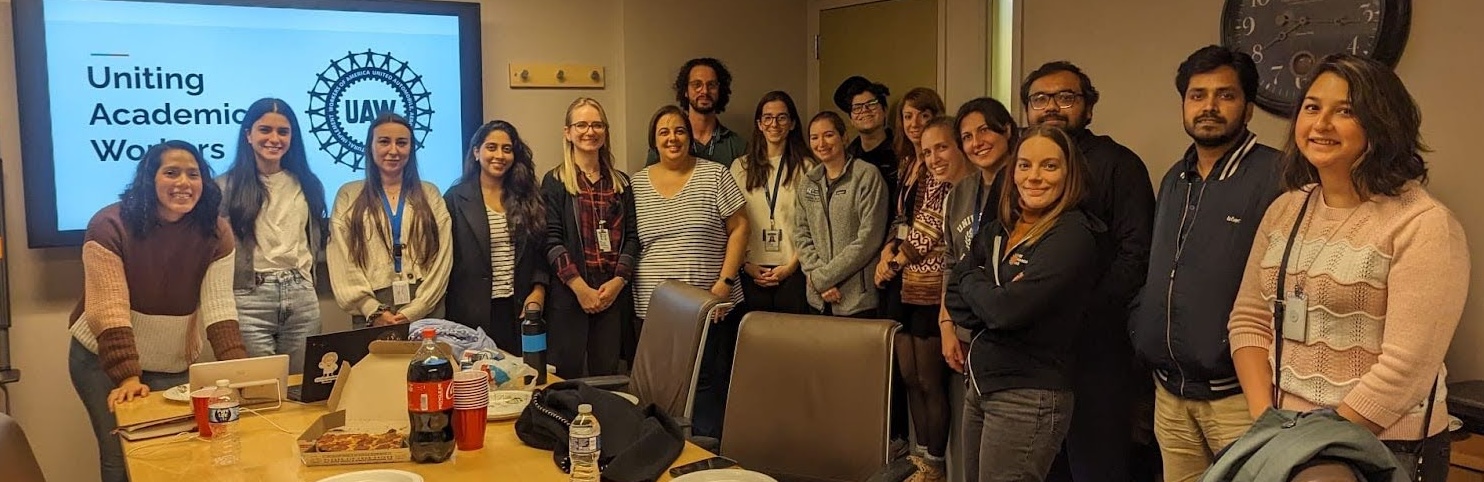
A stronger voice to advocate for International Worker rights.
With nearly 120,000 academic workers across the US, including postdocs, student workers, and non-tenure-track faculty, the UAW has become a leading voice advocating for expanded rights and opportunities for international academic workers, including students transitioning to early-career research positions like postdocs, in the US as well as for robust federal investment in science research. UAW academic workers’ advocacy work also played a key role in ensuring the inclusion of postdocs in the 2016 federal overtime rules and, most recently, increased NIH pay levels for pre- and postdoctoral researchers announced in April 2024.
International researchers have played a significant role in the leadership of UAW, which has in turn helped make international worker issues central to the UAW’s mission, particularly in higher education. Postdoc and graduate employee unions affiliated with UAW are often led by international students and scholars, who serve in top leadership positions in local unions nationwide.
Joining together with other academic workers in the UAW has become more urgent than ever as recent government actors have waged unprecedented attacks on science, sexual harassment protections, and the rights of international scholars.
Letter to the editor: UAW is a strong ally for international students and postdocs
As International Researchers at Columbia University we are voting Yes for our Union
Read about UC postdoc and UAW efforts to support federal science funding
UAW 5810 Resolution To Mt. Sinai Postdocs on International Researcher Rights
“As a European postdoc in the US, I understand the stress associated with moving to a different continent and culture, facing intricate visa hurdles and inadequate social support systems, let alone the challenge of adjusting to new workplace norms. A union will give us more power to collectively address the specific stressors international postdocs face by negotiating for streamlined visa processes and more inclusive policies.”
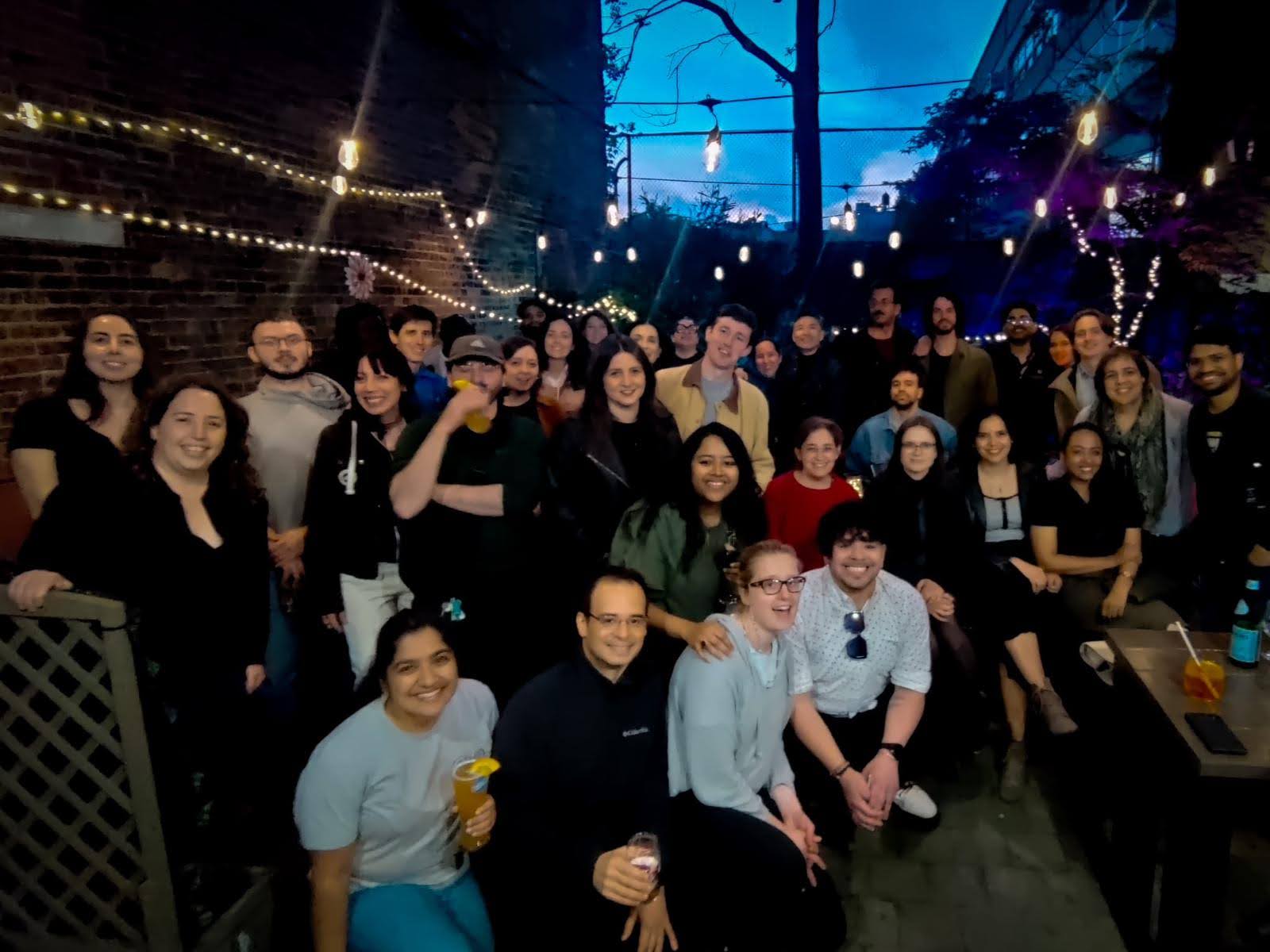
Einstein postdocs met up with unionized colleagues in the UAW from Columbia, Mount Sinai, Weill Cornell Medicine, and New York University for a social event this spring.
Our research is stronger when everyone can contribute.
Pregnancy, childbirth and adoption should be occasions for celebration – without unnecessary stress caused by having to return to work too soon after giving birth, or concerns about unstable benefits, housing, or visa status. Unfortunately, this kind of stress is all too prevalent for postdoc parents. Women postdocs with families in particular face discrimination and unequal pressures, making them far more likely than men to leave academia before obtaining tenure at a college or university.
Under-representation of women in senior roles has been a longstanding problem within academia, and that’s why winning significant improvements in this area is so important.
Read how other postdocs have unionized and made their employers more family friendly.
Why Sinai postdoc parents voted “YES” for a more family-friendly research community
Columbia graduate workers win fully-paid dependent health insurance
Columbia Postdocs Win Emergency Child Care Subsidy During Pandemic
“Work-life balance disproportionately affects women in science, especially when starting a family, and many are forced out of the profession as a result. Forming a postdoc union would empower us to establish more equitable policies for mothers and minorities at Einstein, which will contribute toward a better future for women in academia.”
Together we can make Einstein more equitable and inclusive.
Inequalities based on gender, race, sexual orientation and immigration status continue to create barriers for many of the most talented to enter the academic and scientific workforce. Existing systems of recourse for problems like discrimination, harassment, and bullying too often fail and can take years. Though much work remains to be done, postdocs, graduate students and adjunct faculty in the UAW have helped make progress on many of these issues, both at the bargaining table and in policy advocacy through the UAW. At the University of Connecticut, for example, a graduate assistant worked with her union to successfully resolve a major sexual assault and harassment complaint in three months.
UConn Graduate Student Union Helps Handle Sexual Harassment
“Workplace Bullying in Higher Education is Rampant. We’re Fighting Back”
UC International Postdoc Takes on Pregnancy Discrimination and Wins
“I consider it important, indeed urgently necessary, for intellectual workers to get together, both to protect their own economic status and, also generally speaking, to secure their influence in political field.”
We are voting YES for our union, Einstein Researchers United-UAW (ERU-UAW)!
On May 15th and 16th, we will have the opportunity to vote “union yes” at Einstein. In doing so, we would join tens of thousands of unionized academic workers across the US, including thousands of postdoctoral researchers who have already come together to raise standards across New York City and create a more equitable, inclusive, and fair scientific community.
As postdocs, we play a critical role in driving the world-class research conducted at Einstein. However, without collective bargaining, Einstein postdocs have faced unreliable salary increases that lag behind the rising cost of living, lack of clear recourse in cases of mistreatment, and insufficient support for international researchers and parents, among other challenges. This uncertainty unnecessarily hinders our ability to focus on quality research.
If a majority of us vote “yes” for ERU-UAW as our union, the Einstein administration would be legally obligated to bargain with postdocs over salaries, benefits and workplace rights, and to commit any agreements into a binding contract.
We therefore urge our colleagues to vote ‘yes’ for ERU-UAW as our union, so that we have the strongest possible mandate to bargain a fair union contract with the Einstein administration that improves our working conditions and our lives.
Signed,
Juliane Grimm, Cell Biology
Silvia Hernandez, Medicine – Cardiology
Anna Adam-Artigues, Cell Biology
Priyanka Parmar, Pathology
Taiane Nascimento de Souza, Medicine – Infectious Diseases
Ludovic Spaeth, Neuroscience
Michael Papanicolaou, Cell Biology
Tushar Arora, Neuroscience
Rayna Birnbaum, Medicine – Molecular Pharmacology
Richard Garcia Betancourt, Medicine – Microbiology & Immunology
Amanat Ali, Medicine – Endocrinology
Shanika Jayakody, Medicine – Geriatrics
Nivedita, Developmental and Molecular Biology
Johanna Heid, Genetics
Carlos Rivero, Neuroscience
Kelly Cotton, Neurology
Anil Shelke, Biochemistry
Andrew Miller, Pathology
Rohan Misra, Genetics
Annie Maguire, Neuroscience
Paulina Alatriste Gonzalez, Cell Biology
Erika Pereira Zambalde, Pathology
Vinay Kumar, Medicine – Cardiology
Romina Deza Ponzio, Medicine – Molecular Pharmacology
Beata Malachowska, Radiation Oncology
Bethany Terry, Genetics
Randall Carpenter, Cell Biology
Julia Wang, Neuroscience
Victoire Leroy, Neurology
Carolina Rodriguez, Medicine – Microbiology & Immunology
Chava Pollak, Neurology
Susheian Kelly, Cancer Center